
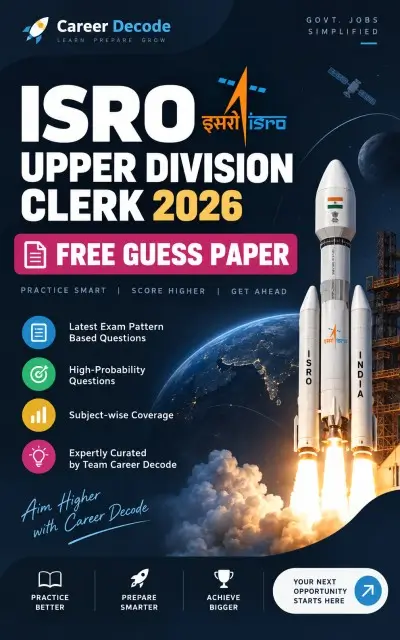
ISRO Upper Division Clerk 2026 Free Guess Paper
ISRO Assistant UDC 2026 exam pattern, syllabus weightage, and a section-by-section strategy for the 200-mark written test. Plan your prep now.
ISRO closed its application window for 242 posts across Assistant, UDC, JPA, and Stenographer on August 16, 2026. The admit card came out on September 10, and the written test runs on September 21, 2026. Aspirants now have a short, fixed window to convert syllabus knowledge into a working test strategy, and the section-wise structure of this paper rewards a different approach than most SSC exams.
TL;DR
- The written test carries 200 questions for 200 marks in 150 minutes, with a 0.25-mark penalty for each wrong answer.
- Assistant and UDC candidates face four equal sections of 50 marks each. JPA and Stenographer candidates face a language-heavy pattern with 100 marks in English alone.
- Candidates must clear 50% marks (UR) or 40% marks (reserved categories) in every section to reach the skill test stage.
- The skill test is qualifying only. Final merit comes from the written test score alone, with no interview round.
- ISRO Assistant and UDC posts sit at Pay Level 4 (basic pay ₹25,500), a full level above the equivalent SSC CHSL LDC/JSA post.
- The syllabus subjects match the SSC CGL and CHSL pattern closely, so candidates already trained for SSC can redirect that preparation with minor adjustments.
Why This Recruitment Cycle Matters
ISRO releases Assistant and UDC vacancies far less often than SSC does. A candidate who treats this exam as a smaller, less-important cousin of SSC CGL risks missing an opening that will not repeat for years. The application volume for a space-agency post also tends to run lower than SSC’s mass-scale exams, since many aspirants default to SSC without checking ISRO’s own recruitment calendar.
Key Dates and Numbers at a Glance
The table below lists the fixed data points every candidate needs before building a study plan.
| Particular | Detail |
|---|---|
| Advertisement Number | ISRO:ICRB:01(A-JPA):2026 |
| Total Vacancies | 242 (Assistant, UDC, JPA, Stenographer combined) |
| Application Window | July 27 - August 16, 2026 |
| Admit Card Release | September 10, 2026 |
| Written Exam Date | September 21, 2026 |
| Pay Level | Level 4 |
| Starting Basic Pay | ₹25,500 per month |
| Upper Age Limit | 28 years (relaxation applies for reserved categories) |
| Minimum Qualification | Bachelor’s degree with 60% marks, or CGPA 6.32 out of 10 |
The Written Test Splits Into Two Different Papers
ISRO does not run one common paper for every post. The Assistant and UDC paper tests four subjects in equal measure. The JPA and Stenographer paper shifts most of its weight to English. A candidate who studies for the wrong pattern wastes preparation time on sections that barely appear in their actual paper.
ISRO Assistant / UDC Written Test Structure
| Section | Questions | Marks |
|---|---|---|
| General English | 50 | 50 |
| Quantitative Aptitude | 50 | 50 |
| General Intelligence & Reasoning | 50 | 50 |
| General Knowledge | 50 | 50 |
| Total | 200 | 200 |
ISRO JPA / Stenographer Written Test Structure
| Section | Questions | Marks |
|---|---|---|
| English Language & Comprehension | 100 | 100 |
| General Intelligence & Reasoning | 50 | 50 |
| Quantitative Aptitude & General Knowledge | 50 | 50 |
| Total | 200 | 200 |
An Assistant or UDC candidate cannot let one section dominate preparation time, because each section holds exactly 25% of the total marks. A JPA or Stenographer candidate faces the opposite situation. English alone decides half the score, so weak grammar or slow reading speed costs more marks here than in almost any other central government exam.
Why the SSC-Pattern Syllabus Works in Your Favor
The four subjects in the Assistant/UDC paper (English, Quantitative Aptitude, Reasoning, and General Knowledge) match the core subjects tested in SSC CGL and SSC CHSL. Topics such as number system, percentage, simple and compound interest, analogy, series, and current affairs repeat across all three exams. A candidate already mid-way through SSC preparation does not need to start over. The main adjustment is topic depth: ISRO’s paper stays closer to fundamentals and moves less into the advanced, multi-step problems that SSC CGL Tier 2 tests.
Clearing Sectional Cutoffs Is the Real Filter
ISRO applies a qualifying mark in every individual section, not just the overall paper. Unreserved-category candidates need 50% marks in each part, while reserved-category candidates need 40% marks in each part. A candidate who scores high overall but drops below this line in even one section gets rejected before the skill test stage. This rule pushes preparation away from a “strong subject, weak subject” strategy and toward balanced coverage of all four areas.
The Skill Test Does Not Decide Rank
Candidates who clear the sectional cutoffs move to a Computer Literacy Test covering MS Word, MS Excel, and MS PowerPoint. JPA and Stenographer candidates also sit a stenography test. ISRO shortlists candidates for this stage in a ratio of roughly 1:5 against category-wise vacancies. The skill test result only qualifies or disqualifies a candidate. It does not add marks to the final merit list, which is built entirely from the written test score. This structure removes interview-stage uncertainty and rewards candidates who peak on exam day rather than in a later round.
Salary Comparison: ISRO Assistant/UDC vs. SSC CHSL LDC/JSA
Aspirants preparing for both SSC CHSL and ISRO Recruitment often ask which post pays more at entry level. The starting pay levels differ by a full grade.
| Post | Pay Level | Starting Basic Pay |
|---|---|---|
| ISRO Assistant / UDC | Level 4 | ₹25,500 |
| SSC CHSL LDC / JSA | Level 2 | ₹19,900 |
| SSC CGL Tax Assistant / UDC | Level 4 | ₹25,500 |
ISRO Assistant and UDC posts start at the same pay level as several mid-tier SSC CGL posts, not at the entry-level LDC/JSA pay scale under SSC CHSL. This gap matters for candidates choosing where to focus limited preparation hours in a season with overlapping exam calendars.
Building a Study Plan From Previous Year Papers
ISRO’s paper repeats the same general structure year after year, which makes previous year papers a reliable planning tool. Coaching platforms recommend solving at least five to seven years of past papers to spot recurring topics inside each section. General Knowledge, in particular, rewards this approach because it draws heavily on static topics like Indian history, geography, and polity, alongside recent current affairs, rather than unpredictable one-off questions.
What This Means for Your Next Four Weeks
With roughly one month between the admit card release and the exam date, candidates have limited room for building new skills from scratch. The practical move is to lock a daily split across all four sections, protect the sectional cutoff in the candidate’s weakest subject first, and use previous year papers to confirm which topics inside each section carry the most repeat value. Candidates who already have an SSC-style base can spend this window narrowing focus rather than relearning fundamentals, which is the main advantage a lower-competition, SSC-pattern exam like this one offers.
Common Questions
Is the ISRO Assistant/UDC syllabus the same as SSC CGL? The subjects match closely: English, Quantitative Aptitude, Reasoning, and General Knowledge. Topic depth stays closer to CHSL-level fundamentals than to CGL Tier 2 difficulty.
Does ISRO conduct an interview for these posts? No. Selection depends on the written test score and a qualifying skill test. There is no interview stage.
What happens if I clear the overall cutoff but fail one section? Candidates must clear the qualifying mark in every individual section. Failing one section disqualifies the candidate regardless of the overall score.
How many vacancies are open for the Assistant post specifically? Within the combined 242 vacancies, the Assistant post accounts for 130 openings, split across two post codes.
Is negative marking applicable? Yes. Each wrong answer costs 0.25 marks, deducted from the total score.
You may also find useful
NCRTC Supervisor Electronics 2026 Free Guess Paper
NCRTC Supervisor Electronics 2026: exam pattern, CBT syllabus, salary, and a section-wise …
ISRO ISTRAC Technical Assistant (Electronics) 2026 Free Guess Paper
ISRO ISTRAC Technical Assistant (Electronics) 2026: exam pattern, syllabus, cut off …
CISF ASI X-Ray Technician 2026 Free Guess Paper
CISF ASI X-Ray Technician 2026 has one open seat. Check eligibility, exam pattern, salary, …
ISRO Junior Personal Assistant 2026 Free Guess Paper
ISRO JPA Stenographer 2026 exam pattern, subject-wise weightage, stenography test rules, …