
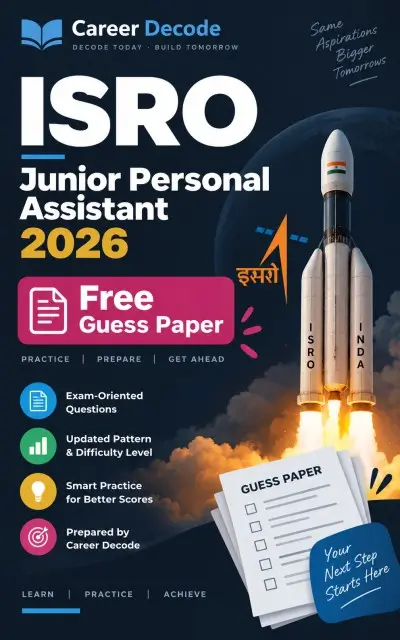
ISRO Junior Personal Assistant 2026 Free Guess Paper
ISRO JPA Stenographer 2026 exam pattern, subject-wise weightage, stenography test rules, and a section-wise study plan ahead of the September CBT.
The ISRO Junior Personal Assistant (JPA) and Stenographer written test falls on September 21, 2026. Every aspirant now has under a week left. A close read of the ISRO JPA Stenographer 2026 exam pattern shows one subject carries half the total marks, so a wrong study split can cost a rank even with solid overall preparation.
TL;DR
- The JPA/Stenographer written test carries 200 marks across three parts, and English Language & Comprehension alone holds 100 marks, half the paper.
- ISRO revised total vacancies to 267 across Assistant, JPA, UDC, and Stenographer posts, but the JPA/Stenographer share stays near 92 posts, since the August revision added seats only to Assistant and UDC.
- Selection runs through three stages: the written CBT, a stenography skill test, and a computer literacy test.
- The stenography test demands 60 words per minute shorthand speed on a 300-word, 5-minute dictation, transcribed in 30 minutes using Pittman shorthand only.
- The written test carries negative marking of 0.25 marks per wrong answer, so guesswork on General Knowledge or Quantitative Aptitude questions can lower a score fast.
- Selected candidates join Level 4 of the Pay Matrix with a minimum basic pay of ₹25,500 a month.
ISRO JPA Stenographer 2026 Exam Pattern: Subject-wise Marks
The JPA/Stenographer paper differs from the Assistant/UDC paper in one key way. English carries double the weight here, because clear language skills feed directly into accurate stenography and transcription work.
Advertisement
| Part | Subject | Questions | Marks |
|---|---|---|---|
| A | English Language & Comprehension | 100 | 100 |
| B | General Intelligence & Reasoning Ability | 50 | 50 |
| C | Quantitative Aptitude & General Knowledge (combined) | 50 | 50 |
| Total | 200 | 200 |
The test runs for 150 minutes in online mode. Each correct answer earns 1 mark. Each wrong answer costs 0.25 marks. This marking scheme rewards accuracy over speed guessing, particularly in the combined Quantitative Aptitude and General Knowledge section, where two unrelated subjects share only 50 marks.
Why the English Weightage Changes the Preparation Plan
A candidate who scores 80 out of 100 in English gains more ground than a candidate who scores 40 out of 50 in Reasoning, purely because of the marks on offer. Aspirants preparing for other exams with similar English, Reasoning, and General Knowledge syllabi can reuse most of their existing study material here. The shift needed is in time allocation, not in new topics.
Selection Process: Three Stages Aspirants Must Clear
ISRO builds the JPA/Stenographer selection process around three separate checkpoints. A candidate must clear each stage in sequence.
- Written Test (CBT): This paper alone decides the final merit list rank. A weak score here removes a candidate from the process regardless of stenography or computer skill.
- Stenography Skill Test: Only candidates who clear the CBT and opted for stenography attempt this stage. It is qualifying in nature, not part of the final merit score.
- Computer Literacy Test: This stage checks practical MS Word, MS Excel, and MS PowerPoint skills and applies to every shortlisted candidate.
Because the written test alone sets the merit rank, aspirants must treat Parts A, B, and C of the CBT as the single highest-value target in their preparation.
Stenography Test: Speed, Format, and Error Tolerance
The stenography test uses a dictation of 300 words delivered at 60 words per minute over 5 minutes. Candidates then get 30 minutes to transcribe the shorthand into English on a computer, using Pittman shorthand exclusively. A transcript written in any other shorthand method or in longhand does not get evaluated.
Errors fall into two categories. A full mistake covers any omitted word, wrongly substituted word, or added word not present in the dictated passage. A half mistake covers wrong spelling, incorrect singular or plural use, or a wrongly capitalized letter. General category candidates may make up to 10% errors, while reserved category candidates against reserved seats may make up to 12% errors, calculated against the total word count of the passage.
Computer Literacy Test: MS Word, Excel, and PowerPoint Breakdown
Every JPA and Stenographer candidate who clears the earlier stages sits the same computer literacy test, worth 100 marks over 75 minutes.
| Module | Marks |
|---|---|
| MS Word | 35 |
| MS Excel | 35 |
| MS PowerPoint | 30 |
| Total | 100 |
General category candidates need 60% marks to pass this test. Reserved category candidates need 50% marks. The test covers practical tasks such as formatting, tables, formulas, mail merge, and slide creation, so hands-on software practice matters more than reading theory.
Eligibility and Age Limit for ISRO JPA / Stenographer Posts
A candidate must hold a graduation degree with 60% marks or a 6.32 CGPA on a 10-point scale. A Diploma in Commercial or Secretarial Practice with the same 60% or 6.32 CGPA also qualifies. Candidates must also show a minimum stenography speed of 60 words per minute in English. The age limit runs from 18 to 28 years, with standard government relaxation for reserved categories.
ISRO JPA Stenographer Salary and Application Fee
Selected candidates join Level 4 of the 7th CPC Pay Matrix, with a minimum basic pay of ₹25,500 per month. This basic pay grows with dearness allowance, house rent allowance, and transport allowance, applied at rates set for central government employees. Compared with similar stenographer posts in other central departments, this pay level places ISRO among the more attractive postings, given the added prestige of working within a space research institution.
The application fee for the unreserved category runs to ₹100. Reserved category candidates receive a fee exemption. This low fee, next to the strong starting pay and job security, makes the exam attractive for a wide pool of applicants and pushes up competition at every seat.
Written Test Qualifying Marks
| Category | Qualifying Marks |
|---|---|
| Unreserved | 50% |
| Reserved | 40% |
A candidate must clear this qualifying mark on the combined written test score before ISRO considers the stenography and computer literacy stages. Missing this mark by even one question removes a candidate from the process, regardless of stenography speed.
Subject-wise Strategy: Where to Put Study Hours
Given the 100-mark weight on English, a realistic target sits near 80 out of 100 in that section, covering vocabulary, grammar, and comprehension in equal depth. Reasoning, at 50 marks, rewards drilling standard topics such as coding-decoding, series, and sitting arrangements, with a target near 45 out of 50. The combined Quantitative Aptitude and General Knowledge section, also 50 marks, needs a split approach: quick calculation practice for the math half and daily current affairs review for the general knowledge half.
Stenography preparation runs on a separate track and needs early, consistent practice. Shorthand speed builds over weeks, not days, so candidates who start dictation practice now, alongside CBT revision, enter the stenography stage with far less risk than those who wait until after the written result.
What This Means for Aspirants Going Forward
The ISRO JPA/Stenographer exam pattern rewards candidates who read the mark distribution before opening a single book. English decides half the paper, negative marking punishes blind guessing, and the stenography stage adds a skill that takes weeks to build, not hours. Aspirants who split their remaining days across English depth, Reasoning drills, targeted General Knowledge revision, and daily shorthand practice enter the September 21 test with a clear plan instead of a scattered one.
Common Questions
What is the ISRO JPA Stenographer 2026 exam pattern? The written test carries 200 marks across English Language & Comprehension (100 marks), General Intelligence & Reasoning Ability (50 marks), and combined Quantitative Aptitude & General Knowledge (50 marks), over 150 minutes.
Is there negative marking in the ISRO JPA Stenographer exam? Yes. Each wrong answer costs 0.25 marks, while each correct answer earns 1 mark.
What stenography speed does ISRO require? Candidates need a minimum of 60 words per minute, tested through a 300-word, 5-minute dictation followed by a 30-minute computer transcription.
What is the ISRO JPA salary in 2026? Selected candidates start at Level 4 of the Pay Matrix, with a minimum basic pay of ₹25,500 per month, plus standard allowances.
What is the qualifying mark for the ISRO written test? Unreserved category candidates need 50% marks, and reserved category candidates need 40% marks, to clear the written test.
You may also find useful

NCRTC Supervisor Electronics 2026 Free Guess Paper
NCRTC Supervisor Electronics 2026: exam pattern, CBT syllabus, salary, and a section-wise …
ISRO ISTRAC Technical Assistant (Electronics) 2026 Free Guess Paper
ISRO ISTRAC Technical Assistant (Electronics) 2026: exam pattern, syllabus, cut off …
CISF ASI X-Ray Technician 2026 Free Guess Paper
CISF ASI X-Ray Technician 2026 has one open seat. Check eligibility, exam pattern, salary, …

ISRO Upper Division Clerk 2026 Free Guess Paper
ISRO Assistant UDC 2026 exam pattern, syllabus weightage, and a section-by-section …