
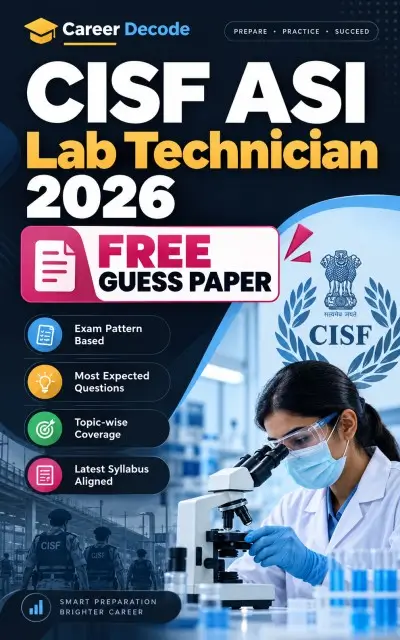
CISF ASI Lab Technician 2026 Free Guess Paper
CISF ASI Lab Technician 2026 exam pattern, syllabus weightage, and a subject-wise strategy to clear the written test and BVAT stage.
CISF released the Physical Standard Test admit card for ASI Paramedical Staff on September 1, 2026, and the physical round is now underway. Candidates who cleared the CISF ASI Lab Technician 2026 written test now enter the harder middle stages of selection. A clear read of the exam pattern and subject weightage still decides the final rank, since the later stages only qualify candidates and add no marks.
TL;DR
- CISF advertised 24 ASI Paramedical Staff posts for 2026, and 5 of these posts belong to the Lab Technician trade.
- The written exam carries 100 marks, runs for 2 hours, and tests only trade-specific knowledge. It has no negative marking.
- The final merit list uses only the written exam score. The Physical Standard Test (PST) and Basic Vocational Aptitude Test (BVAT) act as qualifying gates, not scoring stages.
- Hematology, blood banking, and clinical microbiology form the core of the Lab Technician trade paper.
- Starting pay sits in Level-5 of the 7th Pay Commission, from ₹29,200 to ₹92,300, plus standard central government allowances.
- CISF shortlists candidates for PST, BVAT, and the medical exam at roughly five times the number of vacancies.
CISF ASI Lab Technician 2026: Vacancy and Category Split
CISF Paramedical Staff Recruitment 2026 covers three trades: Pharmacist, X-Ray Technician, and Lab Technician. Pharmacist carries the largest share, with 18 posts, and X-Ray Technician carries a single post. The Lab Technician trade carries 5 posts, split across categories.
| Category | Vacancies (ASI Lab Technician) |
|---|---|
| Unreserved (UR) | 4 |
| OBC | 1 |
| EWS | 0 |
| SC | 0 |
| ST | 0 |
| Total | 5 |
A 5-post drive draws a small, sharp pool of applicants rather than a broad one. This changes preparation math directly. A candidate needs a near-flawless attempt on the trade paper, since even a small drop in accuracy pushes a candidate out of the merit band.
Eligibility and Age Limit for the Lab Technician Post
CISF asks for 10+2 with Science from a recognized board, plus a 2-year Diploma in Medical Laboratory Technology (DMLT) recognized by a Central or State Government body. This qualification bar keeps the applicant pool narrow and technical, unlike a general-duty post open to any stream.
The age window runs from 18 to 28 years, calculated as on the application closing date. OBC candidates get a 3-year relaxation, and SC/ST candidates get a 5-year relaxation. The application fee stands at ₹100 for General, EWS, and OBC candidates, while SC, ST, Ex-Servicemen, and female candidates pay no fee. A low fee widens the applicant base further, so accuracy on the trade paper becomes the real filter, not the cost of applying.
CISF ASI Lab Technician Exam Pattern 2026
The written exam is short, single-stage, and fully objective. This structure rewards focused revision over broad reading.
| Particular | Detail |
|---|---|
| Mode | OMR or Computer-Based Test (CBT) |
| Question type | Objective, multiple choice |
| Total marks | 100 |
| Duration | 2 hours |
| Language | English and Hindi |
| Negative marking | None |
| Subject coverage | Lab Technician trade knowledge only |
The absence of negative marking changes exam-day behavior. A candidate should attempt every question, since an unattempted question scores zero, the same as a wrong answer. Guessing between two options carries no downside here, unlike exams that penalize wrong attempts.
Selection Stages After the Written Exam
CISF runs six stages in sequence: the written exam, PST, document verification, BVAT, a detailed medical exam, and the final merit list.
- Physical Standard Test (PST): CISF checks height, chest measurement (for male candidates), and weight against trade-specific standards.
- Document verification: CISF checks original certificates for education, category, age, and trade registration.
- Basic Vocational Aptitude Test (BVAT): CISF runs a practical, bench-level check of trade skill. For a Lab Technician, this stage checks hands-on ability with lab procedures rather than theory recall.
- Detailed Medical Examination (DME): A candidate who fails this stage may request a Review Medical Examination (RME) under the recruitment rules.
CISF shortlists roughly five candidates for every one vacancy to move into PST, BVAT, and the medical exam. Since the final merit list uses only the written score, a candidate should treat PST and BVAT as fitness checks to clear, not as a place to gain rank.
Subject-Wise Syllabus Weightage for the Trade Paper
The Lab Technician trade paper draws from the diploma curriculum a candidate already studied, organized into these blocks.
| Subject Block | Core Topics |
|---|---|
| Hematology and Blood Banking | Blood cell counts, hemoglobin estimation, ESR, PCV, ABO/Rh grouping, cross-matching, Coombs test, anticoagulants, component storage |
| Clinical Microbiology | Bacterial morphology, sterilization methods, staining techniques (Gram, AFB, Albert’s, India ink), culture media, antimicrobial testing |
| Immunology and Serology | Antigen-antibody reactions, ELISA, Widal, VDRL/RPR, ASO, CRP, RF |
| Clinical Biochemistry | Blood glucose, lipid profile, liver function tests, kidney function tests, enzyme assays |
| Clinical Pathology and Body Fluids | Urine, stool, sputum (including AFB testing), semen, CSF, and serous fluid analysis |
| Histopathology and Cytopathology | Tissue processing, microtomy, H&E staining, FNAC |
| Anatomy, Physiology, and Molecular Biology | Cell structure, organ systems, DNA/RNA basics, PCR, flow cytometry |
| Laboratory Safety | Biomedical waste rules, quality control, Good Laboratory Practice, PPE use |
Hematology and blood banking, together with clinical microbiology, form the largest share of this list. A candidate who builds a strong base in these two blocks first gains the fastest return on study time, since these topics also support the biochemistry and pathology sections through shared lab technique questions.
Recurring Concept Clusters Across Lab Technician Papers
Certain concept clusters repeat across recruitment cycles for lab technician trade papers in Central Armed Police Forces and similar bodies, regardless of the exact wording used in a given year.
- The scientist credited with formalizing germ theory and the century in which this work took place.
- The difference between light microscopy and electron microscopy, and which of the two needs specimen preparation.
- The resolving power of the unaided human eye, stated in millimeters.
- The specific blood cell responsible for oxygen transport, and the distinct roles of platelets and white cells.
- The normal pH range of human blood and why the body holds this range within narrow limits.
- The anticoagulant used to preserve a sample for a Complete Blood Count (CBC).
- The concept of a universal blood donor, and the conditions under which a donor’s blood type gets used without a full cross-match.
- The bacterium responsible for tuberculosis and its genus name.
A candidate should treat these as anchor concepts. Once fixed, each anchor pulls in the surrounding facts (units, ranges, and related test names) with less separate effort.
CISF vs. BSF Lab Technician: A Quick Cross-Exam Comparison
Many Lab Technician candidates prepare for more than one Central Armed Police Force exam at the same time, since the underlying diploma syllabus stays constant. The exam structure, however, differs.
| Feature | CISF ASI Lab Technician | BSF ASI Lab Technician |
|---|---|---|
| Total marks | 100 | 100 |
| Paper split | Single section, trade knowledge only | GK and numerical aptitude (25), Anatomy and Physiology (25), Professional trade subjects (50) |
| Negative marking | None | Varies by notification; check the current BSF notice |
A candidate preparing for CISF alone can skip general knowledge and numerical practice and route all study time into the trade blocks above. A candidate targeting both forces needs a shared trade-topic base, plus separate short blocks for general knowledge and numerical questions to cover the BSF paper.
Selection Strategy: How to Sequence Your Preparation
- Fix the two heaviest blocks first. Complete hematology/blood banking and clinical microbiology before moving to lighter blocks such as histopathology.
- Convert each topic into a short answer key. For every core topic, fix one correct fact, one unit or range, and one related test name. This matches how objective trade questions are framed.
- Attempt full-length trade-only mock sets. Since the exam has no negative marking, practice full attempts under a 2-hour clock rather than partial, accuracy-only drills.
- Reserve a final week for BVAT readiness. Revise hands-on procedures (sample collection, smear preparation, grouping technique) alongside theory, since BVAT tests the same content in a practical form.
- Track the PST standards early. Height, chest, and weight checks happen well before the medical exam, so a candidate should confirm eligibility against the trade-specific standard before the written result stage, not after.
Common Questions
What is the CISF ASI Lab Technician salary in 2026? The post carries Pay Level-5 of the 7th Pay Commission, with a pay band of ₹29,200 to ₹92,300, plus Dearness Allowance, House Rent Allowance, and National Pension System coverage.
Is there negative marking in the CISF ASI Paramedical written exam? No. CISF Paramedical Staff exams carry no negative marking, and an unattempted question scores the same zero as a wrong answer.
What does the BVAT stage check for a Lab Technician candidate? BVAT checks practical, bench-level trade skill rather than written theory. It is a qualifying stage, and marks from this stage do not add to the final merit list.
Can a diploma holder without a Science background in 10+2 apply for ASI Lab Technician? No. CISF asks specifically for 10+2 with Science as the base qualification for this trade, along with the 2-year DMLT diploma.
Does CISF charge an application fee for reserved categories? SC, ST, Ex-Servicemen, and female candidates across all categories pay no application fee. General, EWS, and OBC candidates pay ₹100.
What This Means Next
Only 5 posts sit open under the Lab Technician trade this cycle, so the written exam decides almost the entire outcome before PST and BVAT ever start. A candidate who treats hematology, blood banking, and microbiology as the fixed core, then layers biochemistry, pathology, and safety topics on top, builds a paper-ready base with the least wasted effort. Because the same DMLT syllabus feeds Lab Technician papers across other Central Armed Police Forces and state paramedical cadres through the year, this preparation carries forward to the next notification, not only this one.
You may also find useful
NBEMS Junior Assistant 2026 Free Guess Paper
NBEMS Junior Assistant 2026 exam analysis: exam pattern, syllabus, skill test rules, cut …

OSSC CHSL Prelims 2026 Free Guess Paper
OSSC CHSL Prelims 2026 exam pattern, key dates, cutoff trends, and a selection strategy …
SSC Stenographer Grade C 2026 Free Guess Paper
A selection strategy for SSC Stenographer Grade C 2026: exam pattern, cut off trends, …
SSC Phase 14 Intermediate 2026 Free Guess Paper
SSC Selection Post Phase 14 Intermediate 2026: exam pattern, the new sectional timer, …