
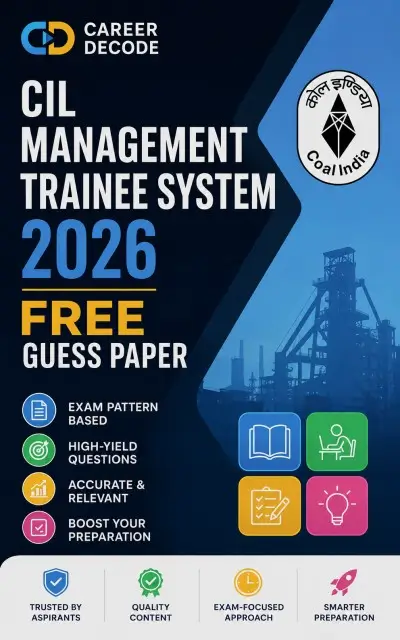
CIL Management Trainee System 2026 Free Guess Paper
CIL Management Trainee System 2026: 43 seats, 42,678 applicants, no interview. Full syllabus, salary, exam pattern, and exam-date status.
Coal India Limited received 42,678 applications for 43 seats in the System discipline of its Management Trainee 2026 drive. That is close to 993 applicants for every one seat. Coal India has not run this exam through direct CBT recruitment for computer science candidates in years. Competition and stakes are both high as a result. The CIL Management Trainee System 2026 process is now past the application stage and moving toward a Computer-Based Test (CBT). The exact date is still unconfirmed as of early August 2026.
TL;DR
- 43 vacancies in the System (Computer Science/IT) discipline, part of 660 total Management Trainee posts across nine disciplines under Advertisement No. 03/2026.
- 42,678 candidates applied for the System discipline alone, a ratio of roughly 993:1.
- Selection runs through a single CBT only. There is no interview and no negative marking.
- The exam has two papers, 100 questions each, in one three-hour sitting: General Aptitude (Paper I) and Professional Knowledge in CS/IT (Paper II).
- Starting basic pay is ₹60,000 per month in a ₹60,000-₹1,80,000 pay scale, with a reported annual CTC near ₹14-20 lakh including allowances.
- As of August 1, 2026, CIL had not released an official exam date. Unverified notices claiming an August 9 CBT date circulated online in late July and did not match CIL’s usual notice format.
Vacancies: Small Numbers, Large Applicant Pool
CIL released 660 tentative vacancies under Advertisement No. 03/2026, spread across Civil, Electrical, Mechanical, System, Electronics & Telecommunication (E&T), Geology, Industrial Engineering, Rajbhasha (Hindi), and Company Secretary disciplines. The System discipline share is small: just 43 posts, against 170 for Civil-scale disciplines and larger allocations for Mechanical and Electrical.
| Discipline | Applications Received |
|---|---|
| Civil | 48,414 |
| System (CS/IT) | 42,678 |
| Mechanical | 38,778 |
Table: Applications received for three of the nine CIL MT 2026 disciplines, based on CIL’s discipline-wise application count.
Why this matters: A low seat count paired with a high applicant count means the qualifying cutoff will likely sit well above the minimum passing marks. Preparation quality, not just coverage, decides the outcome here.
Eligibility: Who Can Apply for the System Discipline
Candidates need a four-year BE/B.Tech/B.Sc Engineering degree in Computer Science, Computer Engineering, or Information Technology from a recognized university, or an MCA. The course must be regular and full-time. Online, part-time, or distance-learning qualifications do not count for technical disciplines like System.
The minimum aggregate mark requirement is 60% for General, OBC-NCL, and EWS candidates, and 55% for SC, ST, and PwBD candidates. Final-year students can apply if their result comes out on or before August 31, 2026.
Why this matters: The final-result deadline gives students who are close to graduation, but not yet done, a real path to apply without waiting for the next recruitment cycle.
The age limit is 30 years as of April 30, 2026. Standard government relaxations apply on top of this: +5 years for SC/ST, +3 years for OBC-NCL, and further relaxation for PwBD and ex-servicemen candidates under central government norms.
Exam Pattern: Two Papers, One Sitting, No Negative Marking
The CBT runs for 3 hours and carries 200 objective questions across two papers, each worth 100 marks.
| Paper | Sections | Questions | Marks |
|---|---|---|---|
| Paper I (General Aptitude) | General Awareness, Reasoning, Numerical Ability, General English (25 each) | 100 | 100 |
| Paper II (Professional Knowledge) | Computer Science / IT subjects | 100 | 100 |
Table: CIL MT System 2026 exam structure. Both papers run in the same three-hour session, and the paper is bilingual (English/Hindi) except for the General English section.
Why this matters: Candidates must qualify both papers separately. A strong Paper II score cannot make up for a weak Paper I score, and the reverse is also true.
There is no negative marking, so every question is worth attempting. Coaching channels analyzing the paper stress that with 200 questions in 180 minutes, quick recall matters more than long derivations, since each question allows under a minute on average.
CIL MT System Syllabus 2026: Where the Weight Sits
CIL has not published a discipline-wise breakdown for Paper II. The topic list below comes from exam-prep channels analyzing the last CIL CBT for the System discipline, held in 2020, and should be treated as an informed estimate rather than an official document.
| Subject | Reported Weight |
|---|---|
| DBMS & SQL | High |
| Computer Networks | High |
| Operating Systems | High |
| Digital Logic | High |
| Data Structures & Algorithms | High |
| C Programming | Medium |
| Theory of Computation | Medium |
| Computer Organization & Architecture | Medium |
| Compiler Design | Low |
Table: Reported subject weight for CIL MT System Paper II, based on past-paper analysis rather than an official CIL document.
Why this matters: These five high-weight subjects reportedly cover 50-60% of Paper II, close to the GATE Computer Science core syllabus. A candidate who has already prepared for GATE has a head start here.
Within those subjects, prep channels flag a few recurring question types: pointer arithmetic and operator precedence in C, CPU scheduling numericals (SJF, SRTF, Round Robin), page replacement algorithms (FIFO, LRU, Optimal), the Banker’s algorithm for deadlock, normalization and B+ trees in DBMS, and IPv4/CIDR calculations in networking.
Salary and Pay Scale: What a Management Trainee Actually Earns
Selected candidates join the E-1 grade with a pay scale of ₹60,000-₹1,80,000. During the one-year training period, starting basic pay is ₹60,000 per month. Once Dearness Allowance, House Rent Allowance, and other components are added, the gross monthly salary typically runs between ₹80,000 and ₹1,20,000+, depending on posting location.
Why this matters: Adding all components together, industry estimates put the approximate annual CTC at ₹14-20 lakh, well above most entry-level PSU postings that do not require a Management Trainee tag.
Selected candidates must sign a service bond of ₹3 lakh and commit to a minimum service period of 60 months (5 years). During this period, ₹5,000 is deducted from salary each month and refunded without interest once the five years are complete.
After completing one year of training and clearing the required internal assessment, trainees are confirmed as Officers in the E-1 grade with full allowances.
Timeline and Exam Date: What’s Confirmed, What Isn’t
Online applications opened on May 12, 2026, and the deadline was later extended to June 21, 2026. As of August 1, 2026, Coal India had not announced the CBT date. The admit card will be issued through each candidate’s individual login on the CIL website, not by post.
Why this matters: In late July 2026, unverified notices claiming a CBT on August 9 and an admit card release on August 2 circulated on social media and messaging groups. Several exam-prep channels flagged this notice as inconsistent with CIL’s standard numbering and bilingual format for official communications, and no such notice appeared on the CIL careers portal. Candidates should treat any exam-date claim from outside the official Coal India website (coalindia.in, under “Career with CIL”) with caution until it is confirmed there.
CIL’s past recruitment pattern for this exam ran the CBT roughly 60 to 90 days after the notification. That points to a test window sometime in August or September 2026. This remains an estimate, not a confirmed date.
Previous Cutoff Trends and What Score to Target
CIL last ran a direct System-discipline CBT in 2020. For that cycle, exam-prep channels report a cutoff in the range of 145-147 out of 200 against roughly 46 vacancies. CIL has not published this figure officially, so treat it as an approximation. More recent Management Trainee cycles, in 2022 and 2024, reportedly used GATE scores instead of a standalone CBT. The 2026 cycle marks a return to the standalone CBT format used in 2017, 2019, and 2020. It drops the interview round those earlier cycles included.
Why this matters: No negative marking, no interview, and a far larger applicant pool this year push the target score higher. Most coaching estimates place a safe target at 150+ out of 200, with some suggesting 160+ as a more comfortable margin. Since final selection depends entirely on the CBT, every mark carries more weight than it did in years with an interview stage.
Common Questions
Is CIL MT System 2026 based on GATE score? No. This cycle uses a standalone Computer-Based Test. GATE was used for CIL Management Trainee recruitment in 2022 and 2024, but not for the 2026 System discipline drive.
How many System discipline seats are open in CIL MT 2026? 43 seats, out of 660 total Management Trainee vacancies across all disciplines.
What is the salary of a CIL Management Trainee (System)? A starting basic pay of ₹60,000 per month, with a pay scale up to ₹1,80,000 and a reported annual CTC of roughly ₹14-20 lakh once allowances are included.
Is there negative marking in the CIL MT exam? No. Candidates can attempt all 200 questions without a marks penalty for wrong answers.
Are MCA graduates eligible for the System discipline? Yes, provided the degree is regular and full-time, with the same 60%/55% aggregate mark requirement that applies to BE/B.Tech candidates.
When is the CIL MT 2026 exam date? Not yet announced as of early August 2026. Candidates should check the official CIL careers portal directly rather than relying on unverified notices.
What This Means Next
The CIL Management Trainee System 2026 cycle sits at a waiting point. Applications are closed, the applicant pool is confirmed at 42,678 for 43 seats, and the next real signal will be the official CBT date on the CIL website. For a candidate preparing now, the best use of this waiting period is closing gaps in the five high-weight Paper II subjects and building speed on Paper I’s aptitude sections. Both papers must be cleared separately, and no interview exists to offset a weak CBT score. Once the admit card appears, expect a short runway. Past CIL cycles have moved from notification to exam in as little as two to three months, and this one is already past that window.
You may also find useful
CIL Management Trainee Industrial Engineering 2026 Free Guess Paper
CIL Management Trainee Industrial Engineering 2026: vacancy count, exam pattern, …
CIL Management Trainee Electrical 2026 Free Guess Paper
CIL Management Trainee Electrical 2026: vacancy count, exam pattern, salary, and a study …

CIL Management Trainee Civil 2026 Free Guess Paper
CIL MT Civil 2026 selection strategy: syllabus changes, subject weightage, difficulty …
SPMCIL Assistant Manager Materials Management 2026 Free Guess Paper
SPMCIL Assistant Manager Materials Management 2026 exam pattern, vacancy trend, and …