
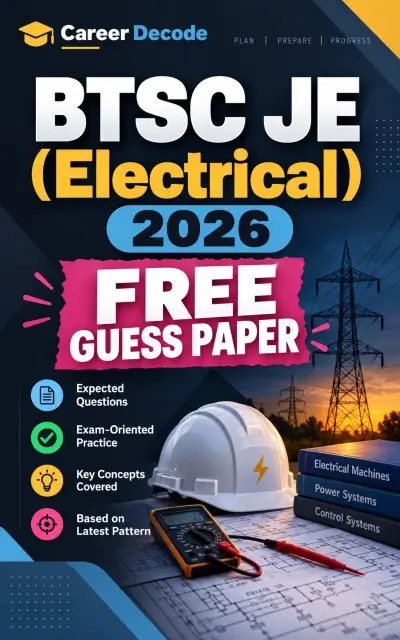
BTSC JE (Electrical) 2026 Free Guess Paper
Vacancy count, eligibility, PYQ trend, and a day-wise plan for BTSC JE Electrical 2026 candidates. Diploma mandatory, 86 posts, written exam carries 75 percent weight.
The Bihar Technical Service Commission closed applications for BTSC JE Electrical 2026 on January 30, 2026, after an earlier deadline extension. Only 86 electrical posts are open, against more than 2,800 junior engineer vacancies across all branches. A small vacancy count raises the cutoff, so every mark in the written exam carries extra weight for aspirants now preparing for the technical paper.
TL;DR
- BTSC JE 2026 has 2,809 total posts: 2,653 civil, 86 electrical, and 70 mechanical.
- A three-year diploma is mandatory. A B.Tech alone does not qualify a candidate.
- The written exam counts for 75 percent of the final score. Experience marks fill the remaining 25 percent, capped at 5 years.
- Candidates from other states can only compete for the unreserved-category share of the 86 posts.
- Basic Electrical, Machines, and Power System together generate close to 45 to 50 questions out of 100 in most recent years.
- Selected candidates draw Grade Pay 4,600 on Pay Level 7, with a pay band of ₹9,300 to ₹34,800.
Vacancy Breakdown and What It Means
BTSC advertised 86 electrical posts under advertisement number 30/2025. Civil carries 2,653 posts and mechanical carries 70. A candidate with an electrical diploma competes in the smallest pool of the three branches. This raises the effective cutoff, because fewer seats absorb the same size of applicant pool. Roughly a quarter of the 86 posts sit in the female-reserved category, so the open male seat count is smaller than the headline number suggests.
Who Can Apply from Outside Bihar
Only the unreserved (UR) category is open to candidates who hold a diploma from outside Bihar’s State Board of Technical Education (SBTE). A Bihar-domicile candidate who studied outside the state, or outside SBTE, also falls into this same unreserved pool rather than the caste-based reserved quota. This detail catches many diploma holders off guard, because domicile alone does not guarantee access to every reserved seat. A candidate should check their own SBTE status before assuming eligibility for a specific reservation category.
Eligibility Rules That Trip Up Candidates
A three-year diploma after Class 10, or a lateral-entry diploma after Class 12 or an ITI course, meets the education requirement. A B.Tech degree adds no separate advantage and does not replace the diploma requirement. This rule blocks direct-B.Tech applicants who skipped a diploma.
The general age limit is 18 to 37 years, calculated against the notified cutoff date. Reserved categories receive standard age relaxation, and the female age limit and BC/EBC limit extend further than the unreserved male limit. Reserved-category and female relaxations follow the state’s standard scale for this post. The application fee is ₹100.
Pay Scale and Career Value
A selected candidate draws Grade Pay 4,600 on Pay Level 7, inside a pay band of ₹9,300 to ₹34,800. This level maps to a starting basic pay in the ₹44,900 range under the current pay matrix, before allowances. This grade pay sits above the 4,200 grade pay many central-government JE posts offer, which explains the high competition for a state post with only 86 seats.
Exam Pattern: Written Score vs Experience Weight
The written test carries 100 questions for 100 marks, all from the technical stream. No separate reasoning or English section applies. Once marked, the raw written score gets scaled down to a 75 percent weight. The remaining 25 percent comes from prior work experience, capped at 25 marks.
Experience marks apply only to contractual junior engineer work, or an equal post, under the Bihar government or a body under its control. An apprenticeship does not count as experience under this rule. Each full year of qualifying experience adds 5 marks, up to a 5-year cap. A candidate with no prior work experience must chase every available mark in the written paper, since the experience column stays at zero for them.
PYQ Trend: Where the Electrical Questions Come From
Past-year question patterns for the electrical technical paper show a concentration in three core areas.
| Topic Area | Approximate Questions per Year |
|---|---|
| Basic Electrical and Circuit Theory | 16 |
| Electrical Machines | 15 |
| Power System | 13 |
| Switchgear and Protection | 7 |
| Utilization of Electrical Energy | 7 |
| Basic Electronics (Analog) | 5 |
| Digital Electronics | 4 |
| Power Electronics and Drives | 3 |
| Control Systems | 2 |
These nine areas account for close to the full 80-question technical share once Measurement questions, which run at a similar count to Switchgear, are added in.
High, Medium, and Low Priority Topics
Grouping the trend data by weight gives a clear study order.
| Priority Band | Topics | Approximate Share of Technical Marks |
|---|---|---|
| High | Basic Electrical, Machines, Power System, Measurement, Switchgear and Protection | 60 to 65 percent |
| Medium | Utilization of Electrical Energy | Remaining mid-range share |
| Low | Analog Electronics, Digital Electronics, Power Electronics, Control Systems | Smaller, but rising in recent papers |
Within Basic Electrical, KCL, KVL, and mesh analysis questions repeat often, and parallel RLC circuit questions have grown more common in recent papers. Within Machines, transformer losses, auto-transformers, DC machine speed control, and induction and synchronous motor curves form the recurring core. Within Power System, cable-related questions appear often. Within Measurement, CRO-based questions score well for prepared candidates. Control Systems sits in the low-priority band but deserves a careful pass, since recent papers have added slightly more questions here than before.
A Day-wise Prep Plan for the Remaining Time
A 50-day study window splits cleanly by priority.
- Days 1 to 20: Cover every high-priority topic in full. Solve topic-wise questions immediately after each section.
- Days 21 to 30: Cover medium- and low-priority topics, plus estimation and illumination formulas from the Utilization section.
- Days 31 to 50: Run full revision cycles and take mock tests on a regular schedule.
A candidate without prior contractual experience should treat the revision phase as the main lever for a higher rank, since the written score is the only variable still open to them.
Self-Study vs Paid Coaching: What Changes the Cost Math
A diploma holder preparing for BTSC JE Electrical faces a real cost choice between self-study and a paid batch. Self-study costs stay near zero beyond books and mock-test subscriptions, but it demands strict personal discipline over the 50-day window above. A paid coaching batch adds a fixed monthly or course fee, but it structures the same 50-day plan into daily sessions and doubt-clearing, which helps candidates who struggle to hold a self-set schedule. A candidate weighing this choice should compare the batch fee against the salary jump a Level-7 post delivers over a lower-grade alternative, since the one-time coaching cost is small next to several years of higher pay.
Common Questions
Can a fresher without work experience clear BTSC JE Electrical? Yes. Experience only adds bonus marks up to a 25-mark cap. A fresher who scores well on the 75-mark written weight can still rank ahead of an experienced candidate with a weak written score.
Does apprenticeship experience count for the 25 experience marks? No. Only contractual junior engineer work, or an equivalent post, under the Bihar government or a body it controls counts toward experience marks.
Can a candidate from another state apply for BTSC JE Electrical? Yes, but only within the unreserved category. Reserved-category seats stay limited to Bihar-domicile candidates who hold an SBTE-recognized diploma.
What is the BTSC JE Electrical age limit? The general limit is 18 to 37 years as of the notified cutoff date, with standard relaxation for reserved categories and female candidates.
What This Means Going Forward
With only 86 electrical posts and a written paper that decides 75 percent of the final score, the highest-return move for most candidates is depth in the five high-priority topic areas rather than broad, shallow coverage of the full syllabus. Candidates should also confirm their own SBTE and domicile status early, since a wrong assumption about category eligibility can rule out an otherwise strong application before the written exam even begins.
You may also find useful
BTSC JE (Civil) 2026 Free Guess Paper
BTSC JE Civil 2026 PYQ analysis covers exam pattern, topic weightage, cutoff trends, and a …

UPSSSC Prelims 2026 Free Guess Paper
UPSSSC Prelims 2026 PYQ analysis: section marks, difficulty trends, fees, and a score plan …
PSSSB Clerk Group C 2026 Free Guess Paper
PSSSB Clerk 2026 falls on October 11. See the exam pattern, Part B weight, and a 20-day …